

The fastest tokenizer for modern LLMs, up to 30x faster.
tuetoken is a BPE tokenizer with a fast, safe Rust core. It is a drop-in replacement
for 🤗 transformers.AutoTokenizer: it loads any model's own tokenizer.json and
reproduces tokenization exactly (special tokens, chat templates, padding/truncation),
up to 30x faster. It also loads OpenAI/tiktoken encodings natively, and
its O(n) merger stays fast even on adversarial inputs (hashes, base64, minified code)
where other tokenizers degrade to O(n²).
from tuetoken import AutoTokenizer

tok = AutoTokenizer.from_pretrained("Qwen/Qwen2.5-7B-Instruct")
out = tok.apply_chat_template(messages, add_generation_prompt=True)   # {"input_ids", "attention_mask"}
Detection is 100% config-driven (the model's tokenizer.json, never its name), so
the same code works across families: Llama, Qwen, Mistral/Mixtral, DeepSeek, Gemma,
Phi, GPT-OSS, GLM, Kimi, and more.
pip install tuetokenBuild from source (development, or a platform with no prebuilt wheel):
git clone https://github.com/tuetoken-org/tuetoken && cd tuetoken
pip install maturin
maturin develop --release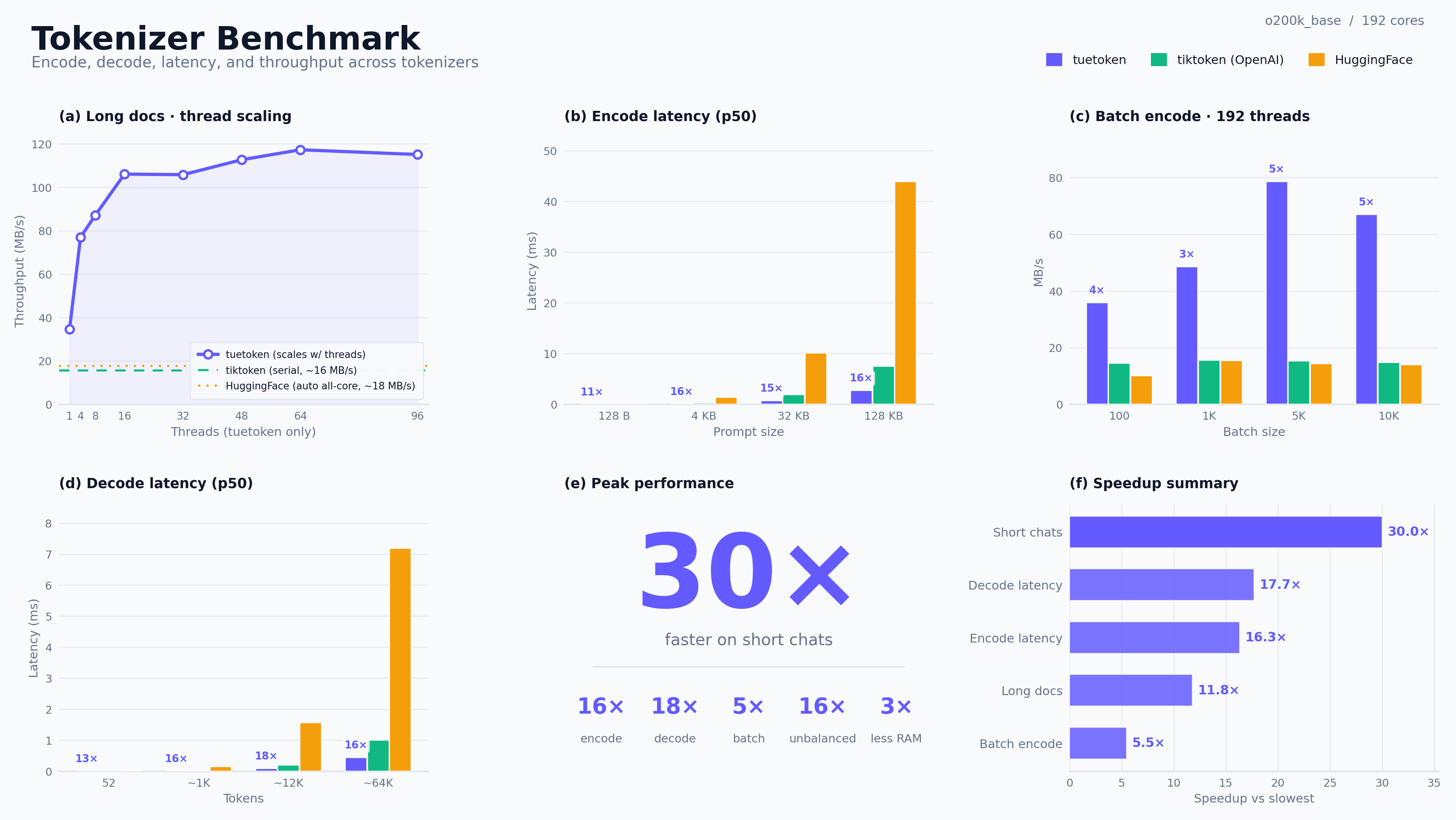
The full 🤗 API, byte-exact with transformers.AutoTokenizer:
from tuetoken import AutoTokenizer
tok = AutoTokenizer.from_pretrained("meta-llama/Llama-3.1-8B-Instruct")

tok.encode("Hello <|eot_id|> world")                 # special-token aware -> list[int]
tok.decode(ids, skip_special_tokens=True)            # -> str
tok(texts, padding=True, truncation=True,            # batch dict: input_ids + attention_mask
    max_length=512, return_tensors="np")             #   (also "pt" for torch)
tok.apply_chat_template(messages, add_generation_prompt=True)  # -> {input_ids, attention_mask}
tok.apply_chat_template(messages, add_generation_prompt=True, return_dict=False)  # -> list[int]
tok.batch_decode(...) ; tok.convert_ids_to_tokens(...) ; tok.tokenize(...)
tok.bos_token_id ; tok.eos_token ; tok.pad_token_id ; tok.vocab_size
This matches transformers.AutoTokenizer token-for-token across byte-level models
(Llama, Qwen, DeepSeek, …) and SentencePiece models (Mistral, Phi-3, CodeLlama, …).
tuetoken loads OpenAI's encodings natively, with no tiktoken dependency, and is
faster than tiktoken itself, by up to an order of magnitude on long inputs:
from tuetoken import Tokenizer
enc = Tokenizer.from_tiktoken("cl100k_base")   # also "o200k_base", "gpt2", ...
enc.encode_ordinary("Hello world") # list[int]Tokenizer is the raw BPE engine (no special tokens or chat templates; that is what
AutoTokenizer is for). Reach for it when you only need fast token ids or counts:
from tuetoken import Tokenizer
enc = Tokenizer.from_pretrained("Qwen/Qwen2.5-7B-Instruct")   # or Tokenizer("tokenizer.json")

enc.encode_ordinary("Hello world")                # list[int]
enc.encode_ordinary_batch(texts, num_threads=0)   # parallel (0 = all cores), GIL released
enc.decode(ids) ; enc.count_tokens("Hi") ; len(enc)
For ML pipelines there are zero-copy numpy paths, a padded training-batch helper, and byte-span offsets:
import numpy as np
arr   = np.frombuffer(enc.encode_to_bytes(text), dtype=np.uint32)   # skip per-token boxing
text  = enc.decode_array(arr)
batch = enc.encode_batch(texts, max_length=512, pad_id=0)           # input_ids + attention_mask
ids, offsets = enc.encode_with_offsets("Hello café") # byte spans, ByteLevel onlytuetoken works with essentially every modern LLM tokenizer: ByteLevel BPE (Llama, Qwen, DeepSeek, Mistral/Mixtral, GPT-OSS, GLM, Phi, OLMo, Yi, …), SentencePiece (Llama-2, Mistral, Phi-3, CodeLlama, Gemma, …), and OpenAI/tiktoken encodings. We extend coverage constantly; if a tokenizer you need isn't supported yet, please open an issue.
Anything tuetoken can't reproduce exactly fails closed (raises at load) rather than mistokenizing, so you never get silently wrong tokens.
Classic BPE is O(n²) per chunk and collapses on long, poorly-merging content (random identifiers, hashes, base64, minified code), tiktoken included. tuetoken's merger is O(n), so adversarial inputs that hang other tokenizers for minutes stay in the millisecond range, byte-identical.
Every claim above is validated byte-exact against the reference tokenizers
(transformers, tokenizers, tiktoken) on a large, adversarial corpus. That is the
only reason those libraries appear in the test dependencies; they are not
runtime dependencies of tuetoken.