


Static contracts for agent-authored Python.
Today an agent that wants to act in the world either asks you to click
"Allow" on every tool call, or gets a blanket grant like "may use email".
clauz3 asks once, and asks a better question:
This program will email only
bob@example.com, at most once. Approve?
The agent writes a small Python program and attaches guarantees about its side effects. A Z3-backed prover checks those guarantees against every branch of the program before anything runs. You approve the guarantees; the program runs only after that, all or nothing.
The guarantees are the thing the user is asked to accept. The program is still available for inspection, but a user should not have to read every branch to answer questions like:
- Will this email anyone other than Bob?
- Will this email the same person twice?
- Will this spend more than $500 in total?
- Will this write outside a sandbox?
Agents increasingly get work done by writing programs that call tools rather
than one tool call at a time. A program has structure a prover can reason
about; clauz3 is built for that input. For how this compares with permission
prompts, sandboxes, guardrails, and runtime policy monitors, see
How ClauZ3 compares.

The email approvals tutorial
(uvx clauz3 ui --tutorial): the agent writes a program to send one mock
email, ClauZ3 proves its guarantees, and the program runs only after you
approve them. Time spent waiting for the agent is sped up.
Want to try it first? The browser-first quickstarts walk through mock email and real file work, with prompts, approval checks, expected results, and terminal alternatives.
A run, end to end. The user asks for a bill to be paid (capped); the agent
writes a small program that looks up the outstanding balance and pays
min(balance, $500); ClauZ3 proves the spend stays under the cap on every
branch and that only the named account is touched; the user approves the
guarantees, not the code; only then does the runtime execute it.
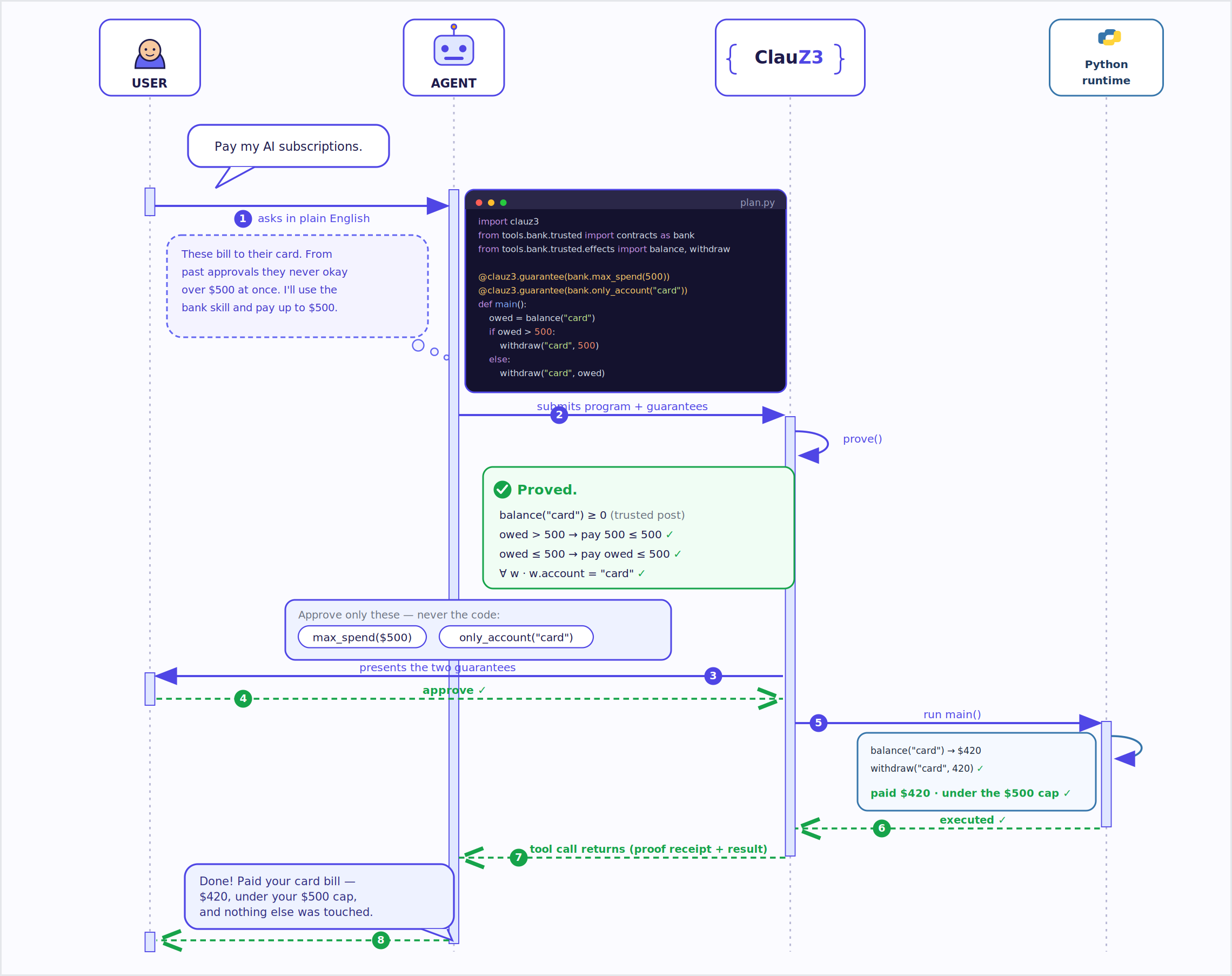
Editable vector source: docs/assets/figure-sequence.svg.

For chat, proof progress, and approvals in one browser workspace:
npm install -g @agentclientprotocol/claude-agent-acp@0.89.1
clauz3 ui claude
The local workspace uses ACP to host Claude and the existing Clauz3 MCP tools to prove and execute actions. It includes streamed conversation, inline approvals, proof diagnostics, a file browser, persistent conversation history, approval profiles, and library management. In a fresh folder, Libraries opens automatically: review an installation, select tools, and start a new conversation. Claude must already be authenticated. See the UI reference for setup and session lifetime.
Try the bundled mock email tutorial without cloning this repository:
uvx clauz3 ui --tutorialThe tutorial uses a separate persistent workspace and sends no email. Your agent still needs its normal setup and authentication. The top-left workspace picker switches between recent folders and tutorials; Reset tutorial starts the exercise over. See the mock email quickstart.
For an agent session, run:
clauz3 start claudeThis starts a localhost approval service, opens its private approval UI, and launches Claude Code in the current folder with program submission, installed-tool discovery, and read-only library search available. In an empty project it offers a library chooser with a File work bundle preselected. It provisions signing keys and separate submission/approver tokens automatically, and stops the service when the agent exits. Claude Code must already be installed and signed in. See the quickstart and start reference.
Both the UI and CLI support claude, codex, agy (Antigravity), opencode,
and pi on macOS and Linux. Claude and Pi support restricted sessions; Codex,
Antigravity, and OpenCode require explicit --unrestricted opt-in. See
agent setup for optional runtimes and
authentication. In clauz3 start claude, --unrestricted enables native Claude
tools for debugging, with Claude's normal permission prompts; those tools can
bypass the clauz3 approval flow. Claude's browser integration remains restricted
and rejects --unrestricted.
Projects are split into two layers:
- trusted roots such as
tools/email/trusted/: small audited modules containing both side-effecting functions and reusable domain contracts. These are the environment contract: the prover trusts their signatures,@clauz3.trustedeffect declarations,@clauz3.requires(...)preconditions, and@contracthelper definitions. - agent-authored code: ordinary Python that imports trusted functions and adds
@clauz3.guarantee(...)decorators to the function being proved.
Trusted calls bottom out into symbolic effect facts. For example:
import clauz3


@clauz3.requires(lambda addr, msg: "@" in addr)
@clauz3.trusted
def send_email(addr: str, msg: str) -> None:
    ...
A call to send_email("bob@example.com", "hi") creates a fact whose relation
name is send_email, whose fields are addr and msg, and whose condition is
the branch condition under which the call is reachable.
Domain logic can query those generated facts:
from clauz3.spec import ContractSpec, contract, effect
from clauz3.spec import no_guarantees as core_no_guarantees

from tools.email.trusted.effects import send_email

Email = effect(send_email)


@contract
def only(addresses: list[str]) -> ContractSpec:
    return Email.all(lambda e: e.addr in addresses)


@contract
def no_guarantees() -> ContractSpec:
    return core_no_guarantees()


@contract
def unique_recipients() -> ContractSpec:
    return Email.distinct(lambda e: e.addr)
Agent code then states guarantees in terms of that vocabulary:
import clauz3
from tools.email.trusted import contracts as emails
from tools.email.trusted.effects import send_email


@clauz3.guarantee(emails.only(["bob@example.com"]))
@clauz3.guarantee(emails.unique_recipients())
def main() -> None:
    send_email("bob@example.com", "hi")
A guarantee must be a call to a registered @contract helper with literal
arguments — see the guarantee
grammar. Agent code
cannot supply its own predicate, so a guarantee is always a claim the trusted
layer defined and the user can look up.
Run the prover:
cd examples/email
uv run clauz3 prove \
  --trusted-root tools/email/trusted \
  cases/only_bob_pass.py
For programs that combine domains, either repeat --trusted-root or pass
several roots with --trusted-roots:
uv run clauz3 prove plan.py \
--trusted-roots tools/email/trusted tools/db/trustedBrowse bundled and curated external libraries with clauz3 libraries, or search
with clauz3 libraries email. Results show dependencies and install commands;
listing never downloads or executes library code.
Library descriptions and setup guidance live in tools/<domain>/clauz3.yaml.
An optional root clauz3.yaml (kind: package) shares prerequisites across
domains; installation snapshots that metadata beside each installed domain.
Legacy libraries with no manifests still install with a warning. A root package
manifest is optional, but declaring one requires valid domain manifests.
See Library manifests and setup.
To start a new project from an existing one, copy its trusted tools/ layer
with clauz3 install. It accepts a local path, a gh:org/repo shorthand, or
a full git URL, and copies each tools/<domain>/ into the current project's
.clauz3/tools/, keeping the project's top level clear:
# Bundled Gmail drafts and sending through gog
clauz3 install stdlib:google_workspace --skills

# Local path
clauz3 install /path/to/repo/examples/email

# GitHub shorthand (clones into ~/.cache/clauz3/sources/<sha>/)
clauz3 install gh:normalform-ai/clauz3-tools-autolabs

# Pin to a tag, branch, or sha for reproducibility
clauz3 install gh:normalform-ai/clauz3-tools-autolabs@v0.3.1

# Full URL (HTTPS or SSH)
clauz3 install git@github.com:normalform-ai/clauz3-tools-autolabs.git
Pass --into <dir> to target a different destination, --force to overwrite an
existing layer, and --skills to also generate
.clauz3/skills/<domain>/SKILL.md describing the installed effects and
contracts:
clauz3 install gh:normalform-ai/clauz3-tools-autolabs --into my-project --skillsUse -g / --global for a reusable user-wide installation, then select it into
individual projects:
clauz3 install -g stdlib:filesystem
clauz3 install global:filesystem
The second command copies filesystem, and any libraries it declares as
dependencies, into this project. Global installations are not automatically trusted by projects;
updating the global copy leaves existing project copies unchanged. The store
defaults to ~/.local/share/clauz3 (honoring XDG_DATA_HOME and CLAUZ3_HOME).
Authentication for git remotes uses your existing git configuration (SSH key
or credential helper); clauz3 does not manage credentials itself. The remote
cache is keyed by the resolved commit sha; pinning to @<sha> hits a stable
entry forever, while ref-pinned or HEAD installs re-resolve on each call and
get a fresh cache entry whenever upstream moves. Override the cache location
with CLAUZ3_CACHE.
The install itself is a filesystem copy. Signing — so a user can verify the installed layer matches what was attested upstream — is tracked in issue #47.
clauz3 ships a small set of real (non-mock) tools under
src/clauz3/stdlib. After pip install clauz3, install
one into the current repo with the stdlib: scheme:
clauz3 install stdlib:filesystem
clauz3 install stdlib:git
The bundled tools are located with importlib.resources, so this works the
same from a source checkout or an installed wheel. (A bare clauz3 install filesystem also works as a shorthand.)
| Tool | Effects | Headline contracts |
|---|---|---|
filesystem |
read_file, grep, find, write_file, copy, move, remove, chmod, ... |
read_only, only_reads_files, only_reads_files_under, only_writes_files, only_writes_files_under, no_deletes |
filesystem states its contracts over the events each tool performs, so one
policy covers every tool: never_read_under refuses read_file, grep, and a
copy or move from the forbidden path. See the full
list of stdlib tools.
These differ from the examples/ layers in two ways: their effect bodies do
real work (so the prover skips them but clauz3 run executes them), and their
proof cases live under tests/cases/ with a tests/Justfile rather than at the
top level. just stdlib proves them all, or run one library's suite directly
with clauz3 test stdlib:filesystem (it invokes the library's tests/Justfile
with just).
The repo has ten worked examples:
| Example | Contracts | What it demonstrates |
|---|---|---|
examples/email |
emails.only, emails.none, emails.no_guarantees, emails.unique_recipients, emails.content_length_at_most |
allowlists, explicit absence of guarantees, absence of effects, pairwise uniqueness, string length bounds |
examples/bank |
bank.max_spend, bank.only_account |
numeric aggregation, field equality, and fixed-bound loop unrolling over trusted calls |
examples/email-from-db |
emails.addresses_from, db.only_table, db.only_where |
for-loops over trusted query returns, column-binding constraints |
examples/text |
text.length_between, text.must_not_contain, text.no_regex_metacharacters, text.only_edit_under, text.edit_length_at_most |
string-length bounds, required/banned substrings, regex-metacharacter safety before sending, and file-edit path/size policies |
examples/http |
http.host_only, http.no_posts |
an explicit relation grouping http_get and http_post, URL-prefix matching, and method-specific absence of effects |
examples/trading |
trading.approvals_only_desk, trading.approvals_only_where, trading.stock_from, trading.shares_from, trading.orders_at_most |
a port of Dogwood's temporal approval-gate policy: an order's stock and quantity must each come from some approval row queried with an approved filter (they are not yet pinned to the same row — see the walk-through) — the same gate expressed as provenance rather than as a window over event history (walk-through) |
examples/gh-triage |
gh.comments_only_where, gh.urls_from |
source- and data-flow provenance: the comment-reading and archive-download tools stay fully general, but contracts pin every consumed comment to a members-only query and every download URL to a release asset posted by a repo member — neutralizing the 10K-repo GitHub malware campaign that baits AI agents into downloading attacker payloads |
examples/lims |
lims.only_plate, lims.total_pipette_volume_at_most, lims.only_instruments, lims.total_runtime_at_most, lims.no_hazard_sequence |
an autonomous-science analog of bank: numeric aggregation, allowlists, and substring guards over pipetting, instrument time, and oligo orders (walk-through) |
examples/home-automation |
home.temp_between, home.only_unlock_doors, home.all_doors_locked_at_end, home.grocery_budget |
everyday-stakes allowlists and budgets, plus fluents for end-state properties such as "every door is locked at the end" (walk-through) |
examples/cloud |
cloud.cap_at_most, cloud.total_caps_at_most, cloud.never_remove_caps, cloud.all_services_capped_at_end |
hard budget caps on agent deploys: per-service and total cap bounds, clamping a cap computed from an unbounded estimate, and a fluent for "no service left uncapped at the end" (walk-through) |
All examples use generic effect relations inferred from trusted function signatures. There is no email-specific, bank-specific, or database-specific logic in the core.
Use *_pass.py for a proved case, *_fail.py for a refuted case, and
*_skip.py for an unsupported construct. Both failure and skip reject
execution, but only failure establishes a counterexample.
The bank, email, cloud, gh-triage, email-from-db, HTTP, and text examples pin exact
conclusions and obligation descriptions in pytest, with discovery checks that
require every case to have a table entry. Home automation, LIMS, and trading
lack complete conclusion tables; their example recipes check negative cases
only for rejection. policy_*.py files are approval-policy fixtures and are
excluded from the proof tables.
The email case while_loop_skip.py shows the skip side of that distinction:
the program is bounded and its guarantee holds, but while is outside the
supported subset, so it skips rather than proves. Its tests pin the prover and
interpreter refusal reasons and check the runner refuses before requesting
approval. The pair aug_assign_fail.py and aug_assign_rewritten_fail.py
shows the other side: msg += ... on a str is desugared to
msg = msg + ..., so both spellings are refuted the same way.
This repo is also a Claude Code skills marketplace. The
.claude-plugin/marketplace.json ships three skills covering the three
clauz3 roles:
clauz3— for an agent that needs to do real-world things in a project whereclauz3is the only outlet.clauz3-authoring— for designing a new trusted layer.clauz3-exploring— for stress-testing agents that talk toclauz3.
Add the marketplace to Claude Code with:
claude plugin marketplace add normalform-ai/clauz3Then install whichever plugin(s) match your role. The skills themselves
live in skills/ and are also usable directly by other harnesses
(--skill /path/to/skills/clauz3/SKILL.md for Pi-style runners).
This is experimental. The current prover vendors and extends deal-solver.
Implemented pieces include:
clauz3 start claudefor launching a restricted agent and its approval service together, with automatic session credentials and cleanup.clauz3.guarantee(...), a no-op runtime decorator consumed by the prover, restricted to calls of registered@contracthelpers over literals.- trusted-call fact recording at
@clauz3.trustedboundaries (a legacy@deal.has(...)carrying markers still works). clauz3.spec.effect(...)for relation-style queries over trusted facts.- relation primitives:
no_guarantees,all,empty,where,count,distinct, numericsum, andshares_value. - stateful fluents (
clauz3.fluent): trusted functions declare successor-state axioms with@effect(...), and contracts query the final valuation withFluent.final.all(...)/Fluent.final[key] == value. This expresses order- and post-state-sensitive policies such as "every door is locked at the end" that the multiset relation language cannot. See docs/reference/fluents.md. clauz3 provefor proving examples from the CLI.clauz3 installfor copying a trustedtools/layer from a local path or a bundled stdlib tool (stdlib:filesystem,stdlib:git) into the project's.clauz3/tools/, optionally generating.clauz3/skills/<domain>/SKILL.mdstubs.clauz3 testfor running a library's bundledtests/Justfilewithjust, resolving the source the same way asinstall.clauz3 lintfor checking a trusted layer's optional deal markers against what its bodies actually do.clauz3 configfor writing this repo's default Claude Code permissions (read-only tools plus theclauz3CLI) to.claude/settings.json. Idempotent and the configuration counterpart toinstall.clauz3 runfor proving a complete inline program, submitting an approval request to an externally configured approval service, and executingmainonly after a signed approval receipt is verified. Verification is fail-closed:runrefuses to execute unlessCLAUZ3_APPROVAL_VERIFY_KEYis provisioned. Useclauz3 approval-keygento generate the keypair (signing key for the service, verifying key for the runner); see docs/how-to/approval-service.md.clauz3 approval-keygenfor generating the Ed25519 approval-signing keypair.clauz3 approval-servicefor starting a simple localhost FastAPI approval service with REST endpoints and a browser UI for user decisions. With--policy, a policy admin's rules can auto-approve or auto-reject a request by asking the prover whether the program entails the rule's contracts, falling back to a human otherwise.clauz3 policy-checkdry-runs a policy against a program. See docs/todos/approval-policies.md.clauz3 mock-approval-servicefor config-driven tests and local demos.clauz3.mcp.MCPClientis a small helper for TLEs who want to wrap an existing untrusted MCP server in a trusted layer: a shorteffects.pyshim forwards calls into the upstream server while carrying the usual@clauz3.trusteddeclarations and contracts that clauz3 proves before any side effect runs.startincludes a private, restricted MCP bridge; the standalone MCP service lives in a separateclauz3-mcppackage and is added to a harness asuvx clauz3-mcp. See docs/how-to/mcp.md.- For-loops over
list[Row]-returning trusted calls, with column-binding contracts viaUserRow.emailmarkers. See docs/explanation/symbolic-iteration.md. - Domain coverage policies declared in a trusted-root
policy.py: contracts a domainrecommendeds are flagged in the approval UI when a used domain is under-constrained, and contracts it marksrequiredare conjoined into the proof and rejected if unmet. See docs/reference/coverage-policies.md.
Important limitations:
- Contract helper functions are still executed as builder functions. Their lambda bodies are parsed as a small expression subset, but the helper body itself is not yet fully AST-validated.
- Runtime receipt enforcement in trusted functions is not implemented yet; the
first
runslice requires a receipt before execution and exposes it to the process asCLAUZ3_APPROVAL_RECEIPT. clauz3 runincludes source checks and reduced builtins, but it is not a hardened Python or OS sandbox. The agent harness must still restrict execution to theclauz3command path.- The relation language is intentionally small. Richer string predicates, richer aggregates, Datalog-style rules, and deterministic natural language summaries are future work.
More detail:
- How ClauZ3 compares
- FAQ and terminology
- Concepts
- Background and related work
- Effect specs
- Coverage policies
- Symbolic iteration
- ClauZ3 Python subset
- Approval service
- User approval dialog design
- Guardians synergies
- Ideas
To use a checkout as your everyday clauz3 command, run this from the checkout:
just install-editableThis uses uv tool install --editable . to install a user-wide command in an
isolated tool environment. "Editable" means it loads Python source directly
from this checkout, so edits and git pull updates take effect on the next
launch. If clauz3 is not on your shell's PATH, run uv tool update-shell and
open a new terminal. Remove any earlier clauz3 shell alias or function so it
does not override the installed command.
Keep this checkout on main for everyday use. Exit running sessions before
updating, then launch from the folder the agent should work in:
git pull --ff-only                 # in the clauz3 checkout
just reinstall                    # when dependencies or command definitions change
cd /path/to/your/project
clauz3 start claude
just reinstall refreshes the tool and its dependencies while keeping the
editable link to the checkout where you run the recipe. Tool installation
resolves dependencies from pyproject.toml; it does not use the checkout's
uv.lock. For an isolated feature test using a separate checkout and its
project environment, run from your target project:
uv run --project /path/to/feature-checkout clauz3 start claudeApplication code is grouped under src/clauz3/sessions/ (agent launch and
lifecycle), approvals/ (approval policy, receipts, service and UI), and
libraries/ (discovery, installation and setup). The contract API remains at
clauz3; the prover, interpreter and vendored solver retain their existing
locations.
uv sync --dev
just test


ClauZ3 layers on two upstream projects and would not exist without them:
- deal — the Python runtime contract
engine
@clauz3.requires/@clauz3.ensuresare built on, so every condition a trusted layer states is also enforced at execution. A layer can use deal directly to bound what its own bodies may do; see Extra runtime enforcement with deal. See Static proof vs runtime for how the two layers relate. - Z3 — Microsoft Research's SMT solver,
the back-end the prover compiles every guarantee into. The vendored
deal-solvermachinery is what bridges Python AST and Z3 constraints.