



Annotate, segment, track, and analyze animals or other research targets in video with one reproducible toolchain.
- Overview
- What Annolid Is For
- Documentation & Support
- Quick Start
- Installation
- Using Annolid
- Core Workflows
- Annotation Guide
- Labeling Best Practices
- Tutorials & Examples
- Troubleshooting
- Docker
- Citing Annolid
- Publications
- Additional Resources
- Acknowledgements
- Contributing
- License
Annolid is a deep learning toolkit for behavior analysis and video annotation. It brings annotation, instance segmentation, tracking, keypoint workflows, behavior scoring, and downstream analysis into one GUI and CLI environment.
The common path is practical and iterative: label a representative frame, propagate or track instances, review difficult frames, repair identities, and export annotations or metrics for analysis. Annolid is designed for real lab data, including overlap, occlusion, variable lighting, long videos, and projects where saved annotations need to remain readable and reproducible.
Python support: Annolid runs on Python 3.10–3.14 for the default GUI/core workflow. The optional remote network video path uses
ffpyplayer; installannolid[remote_video]only when you need that feature, especially on Python 3.14 where native FFmpeg development libraries may be required.
- Markerless multi-animal tracking from a small number of labeled frames.
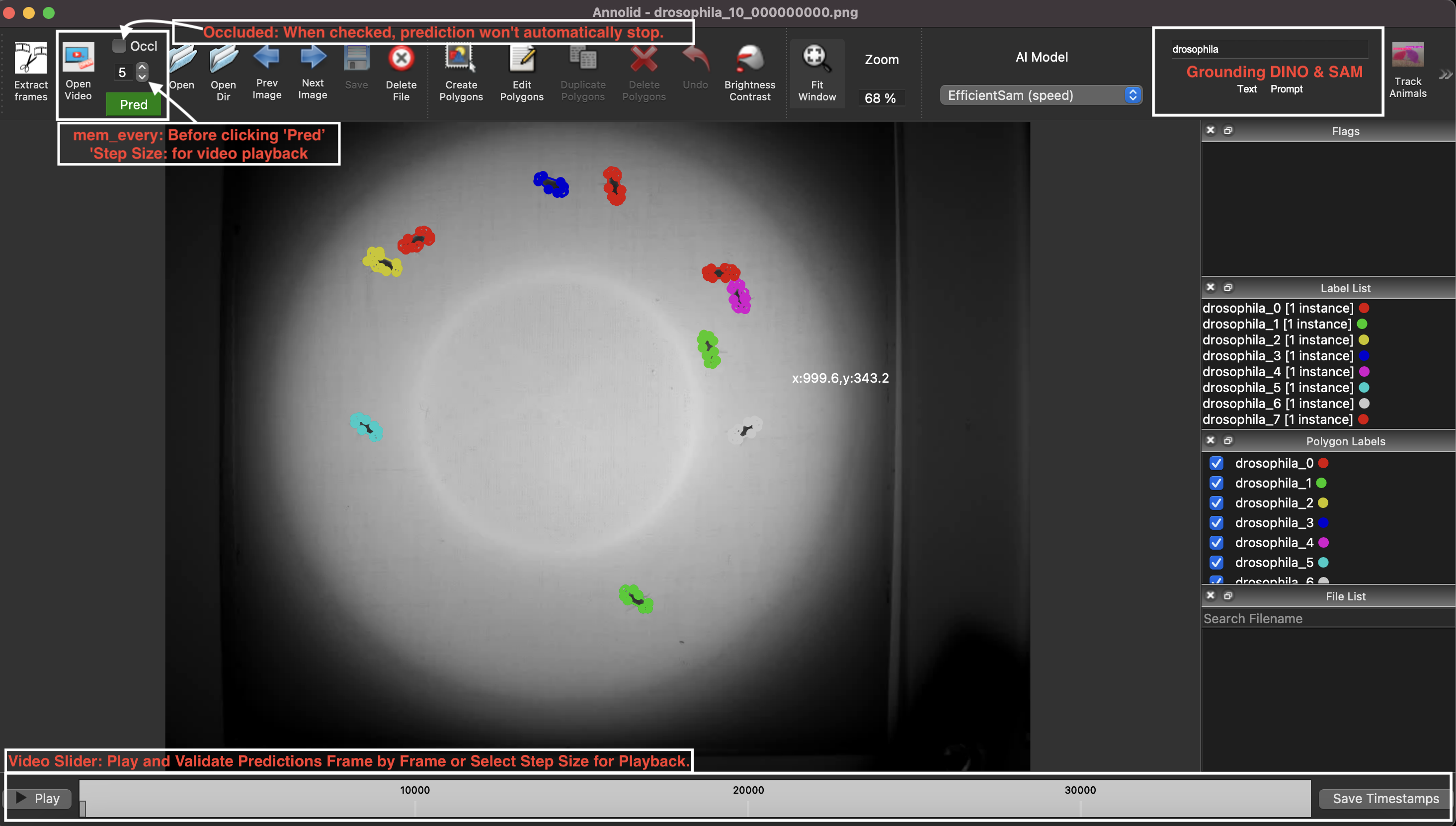
- LabelMe-compatible image and video annotation with polygons, keypoints, zones, and behavior events.
- Foundation-model assisted segmentation and tracking workflows, including Cutie, SAM-family workflows, Grounding DINO, CoTracker-style point tracking, TAPNext ONNX, EfficientTAM, and CowTracker where installed.
- Behavior scoring, timeline flags, zone analysis, time-budget summaries, and classifier workflows.
- GUI-first review and correction, plus
annolid-runCLI commands for reproducible model training, prediction, evaluation, and automation. - Optional Annolid Bot workflows for multimodal assistance, model/plugin execution, MCP tools, and lab automation integrations.
- Large TIFF and atlas-overlay work with optional tiled backends for OME-TIFF, BigTIFF, SVG, and Illustrator/PDF-compatible overlays.
Annolid keeps heavier runtime features behind extras so a standard GUI install stays usable on common lab machines. See Installation for the maintained extras and installer profiles.
- Latest documentation and user guide: https://annolid.com (mirror: https://cplab.science/annolid)
- Community updates and tutorials are shared on the Annolid YouTube channel.
- Sample datasets, posters, and publications are available in the
docs/folder of this repository. - Join the discussion on the Annolid Google Group.
- Tracking Four Interacting Mice with One Labeled Frame | 10-Minute Experiment See how Annolid bootstraps multi-animal tracking from a single labeled frame in a fast end-to-end workflow: https://youtu.be/PNbPA649r78
- For more practical examples and walkthroughs, visit the Annolid YouTube channel.
The fastest maintained path is the one-line installer:
macOS / Linux:
curl -sSL https://raw.githubusercontent.com/healthonrails/annolid/main/install.sh | bashWindows PowerShell:
irm https://raw.githubusercontent.com/healthonrails/annolid/main/install.ps1 | iexAfter installation:
annolid --help
annolid-run --help
annolid
If you prefer Anaconda:
conda create -n annolid-env python=3.11
conda activate annolid-env
conda install git ffmpeg
git clone --recurse-submodules https://github.com/healthonrails/annolid.git
cd annolid
pip install -e ".[gui]"
annolid  # launches the GUI
For source development, use a repository-local .venv:
git clone --recurse-submodules https://github.com/healthonrails/annolid.git
cd annolid
uv venv .venv --python 3.11
source .venv/bin/activate
uv pip install -e ".[gui]"
annolidGet Annolid running in minutes with the automated installer. It clones the repository, creates an isolated environment, bootstraps uv when needed, installs GUI dependencies, and validates the ONNX Runtime provider setup.
macOS / Linux:
curl -sSL https://raw.githubusercontent.com/healthonrails/annolid/main/install.sh | bashWindows PowerShell:
irm https://raw.githubusercontent.com/healthonrails/annolid/main/install.ps1 | iexThe script will:
- Clone the repository.
- Detect your OS and hardware.
- Create an isolated virtual environment.
- Install and validate ONNX Runtime CPU/GPU providers.
- Prompt for optional features such as SAM3 and text-to-speech when requested.
- Offer to launch Annolid immediately.
For a full breakdown of one-line installer choices, including GPU vs CPU, interactive vs non-interactive, custom paths, Conda, and extras, see One-Line Installer Choices.
Common maintained workstation profile:
curl -sSL https://raw.githubusercontent.com/healthonrails/annolid/main/install.sh | bash -s -- --profile workstationFor advanced users, Docker, Conda, or manual Pip installation, please see the Detailed Installation Guide.
- Launch the GUI:
conda activate annolid-env
annolid
- Provide custom labels:
annolid --labels=/path/to/labels_custom.txt
- Draw shapes on a seed frame, often frame
0, and use stable instance names when cross-frame identity matters. - Mark zones directly in the label popup with Zone type, or use Video Tools → Zones for bulk zone management, presets, and zone JSON save/load.
- Use View → Show Zones On All Frames to control whether saved zone overlays are displayed across the full timeline.
- Open Video Tools → Zone Analysis to export legacy place-preference CSVs, generic zone metrics, or profile-aware assay summaries. See Zone Analysis and Zone Analysis Workflow.
- For behavior scoring with shared behavior names across Flags, Timeline, and Annolid Bot, see Behavior labeling with Timeline, Flags, and Annolid Bot.
- Use
annolid-run list-models,annolid-run help train, andannolid-run help predictfor CLI model workflows. - Open AI & Models → Annolid Bot… when you need multimodal chat, typed model/plugin execution, MCP integrations, or optional lab-automation channels. See Agent and Automation, MCP, and Annolid Agent and annolid-run.
- Summarize annotated behavior events into a time-budget report (GUI: File → Behavior Time Budget; CLI example with 60 s bins and a project schema):
python -m annolid.behavior.time_budget exported_events.csv \ --schema project.annolid.json \ --bin-size 60 \ -o time_budget.csv - Compute aggression-bout counts (for example
slap_in_face,run_away, andfight_initiation) and export a_bouts.csvsidecar:python -m annolid.behavior.time_budget exported_events.csv \ --bout-profile aggression \ --bout-gap-seconds 2 \ -o time_budget.csv - Compress videos when storage is limited:
ffmpeg -i input.mp4 -vcodec libx264 output_compressed.mp4
- Getting Started: shortest path from install to a working GUI session.
- Workflows: supported GUI, Bot, CLI, behavior, depth, 3D, identity-repair, and simulation paths.
- Tutorials: maintained walkthroughs and notebooks.
- Video Depth Anything: GUI depth estimation, checkpoint handling, and
depth.ndjsonoutputs. - TAPNext ONNX point tracking: point-seeded tracking workflow and model-cache behavior.
- CoWTracker point tracking: optional dense point-tracking setup and runtime notes.
- SAM3 guide: SAM3 tracking and agent-assisted long-video tracking.
- Large TIFF and Atlas Overlay Workflow: large image and vector overlay workflow.

- Label polygons and keypoints clearly. Give each animal a unique instance name when tracking across frames (for example,
vole_1,mouse_2). Use descriptive behavior names (rearing,grooming) for polygons dedicated to behavioral events, and name body-part keypoints (nose,tail_base) consistently. - Tune instance colors for review. In the GUI, right-click a label in Labels or a shape row in Label Instances, then choose Change color. Annolid applies the color to every visible instance with that label and remembers the preference in app settings without changing LabelMe JSON files. Use Reset color to return to the automatic palette or project-schema color.
- Accelerate timestamp annotation. While scoring behaviors, press
sto mark the start,eto mark the end,f/bto step ±10 frames, andrto remove events directly from the video slider. - Enable frame-level flags. Launch Annolid with
--flags "digging,rearing,grooming"to open a multi-select list of behaviors. Save selections withCtrl+Sor the Save button; remove events by pressingR. - Customize configuration. The first run creates
~/.labelmerc(orC:\Users\<username>\.labelmercon Windows). Edit this file to change defaults such asauto_save: true, or supply an alternative path viaannolid --config /path/to/file. - Learn more. Additional annotation tips live in
annolid/annotation/labelme.md.
- Label 20–100 frames per video to reach strong performance; the curve in
docs/imgs/AP_across_labeled_frames.pngshows how accuracy scales with annotation volume. - Close the loop with human-in-the-loop training (see
docs/imgs/human_in_the_loop.png): train on initial annotations, auto-label, correct, and retrain until predictions align with human expectations. - Draft labeling guidelines up front—start with this template and adapt it to your species and behaviors.
- Treat each animal instance as its own class when you need cross-frame identity. Use generic class names only when identity consistency is unnecessary, or when you are aggregating across many individuals.
- To generalize to new animals or videos, include diverse examples of each behavior and adjust the training set iteratively.
- Featured demo: Tracking Four Interacting Mice with One Labeled Frame | 10-Minute Experiment
- Behavior workflow tutorial: Behavior labeling with Timeline, Flags, and Annolid Bot
- DINOv3 Keypoint Tracking tutorial: book/tutorials/DINOv3_keypoint_tracking.md
- DINOv3 model selection/download helper:
annolid-run dinov3-models --list


| YouTube Channel | Annolid documentations |
|---|---|
 |
 |

| Instance segmentations | Behavior prediction |
|---|---|
 |
 |

- Video playback errors (
OpenCV: FFMPEG: tag ...or missing codecs): Install FFmpeg via your package manager orconda install -c conda-forge ffmpegto extend codec support. - macOS Qt warning (
Class QCocoaPageLayoutDelegate is implemented in both ...):conda install qtpyresolves the conflict between OpenCV and PyQt. - If the GUI does not launch, confirm the correct environment is active and run
annolid --helpfor CLI usage. - If you see
qtpy.QtBindingsNotFoundError, install GUI dependencies in the active environment:pip install -e ".[gui]"(source) orpip install "annolid[gui]"(PyPI). - For model training/inference from the terminal, use
annolid-run list-models,annolid-run help train,annolid-run help predict,annolid-run help train <model>, andannolid-run help predict <model>. Older--help-modelforms still work. - Built-in model plugins now show curated quick-reference groups such as
Required inputs,Model and runtime, andTraining controlsbefore the full flag list. - Shared YAML run-configs are supported for multiple training plugins (for example
dino_kpseg,maskrcnn_detectron2,yolo,behavior_classifier):annolid-run train <model> --run-config annolid/configs/runs/<template>.yaml(CLI flags still override YAML fields). - YOLOE-26 prompting (text, visual, prompt-free) is available via
annolid-run predict yolo_labelmeand in the GUI video inference workflow (see https://annolid.com/portal/workflows/). - For an interactive TensorBoard embedding projector view of DinoKPSEG DINOv3 patch features, run
annolid-run dino-kpseg-embeddings --data /path/to/data.yaml [--weights /path/to/best.pt]and thentensorboard --logdir <run_dir>/tensorboard(some DINOv3 checkpoints require a Hugging Face token).
Ensure Docker is installed, then run:
cd annolid/docker
docker build .
xhost +local:docker  # Linux only; allows GUI forwarding
docker run -it -v /tmp/.X11-unix:/tmp/.X11-unix/ -e DISPLAY=$DISPLAY <IMAGE_ID>
Replace <IMAGE_ID> with the identifier printed by docker build.
If you use Annolid in your research, please cite:
- Preprint: Annolid: Annotation, Instance Segmentation, and Tracking Toolkit
- Zenodo: Find the latest release DOI via the badge at the top of this README.
@misc{yang2024annolid,
      title={Annolid: Annotate, Segment, and Track Anything You Need},
      author={Chen Yang and Thomas A. Cleland},
      year={2024},
      eprint={2403.18690},
      archivePrefix={arXiv},
      primaryClass={cs.CV}
}

@article{yang2023automated,
  title={Automated Behavioral Analysis Using Instance Segmentation},
  author={Yang, Chen and Forest, Jeremy and Einhorn, Matthew and Cleland, Thomas A},
  journal={arXiv preprint arXiv:2312.07723},
  year={2023}
}

@misc{yang2020annolid,
  author = {Chen Yang and Jeremy Forest and Matthew Einhorn and Thomas Cleland},
  title = {Annolid: an instance segmentation-based multiple animal tracking and behavior analysis package},
  howpublished = {\url{https://github.com/healthonrails/annolid}},
  year = {2020}
}- 2022 – Ultrasonic vocalization study. Pranic et al. relate mouse pup vocalizations to non-vocal behaviors (bioRxiv).
- 2022 – Digging and pain behavior. Pattison et al. link digging behaviors to wellbeing in mice (Pain, 2022).
- SfN Posters:
- 2021: Annolid — instance segmentation-based multiple-animal tracking
- 2023: PSTR512.01 Scoring rodent digging behavior with Annolid
- 2023: PSTR512.02 Annolid: Annotate, Segment, and Track Anything You Need
- For more applications and datasets, visit https://cplab.science/annolid.
- Example dataset (COCO format): Download from Google Drive.
- Pretrained models: Available in the shared Google Drive folder.
- Feature requests & bug reports: Open an issue at github.com/healthonrails/annolid/issues.
- Additional videos: Visit the Annolid YouTube channel for demonstrations and talks.
Annolid's tracking module integrates Cutie for enhanced video object segmentation. If you use this feature, please cite Putting the Object Back into Video Object Segmentation (Cheng et al., 2023) and the Cutie repository.
The counting tool integrates CountGD; cite the original CountGD publication and repository when you rely on this module in your research.
Contributions are welcome! Review the guidelines in CONTRIBUTING.md, open an issue to discuss major changes, and run relevant tests before submitting a pull request.
Annolid is distributed under the Creative Commons Attribution-NonCommercial 4.0 International License.