
Official PyTorch implementation of the following projects:
-
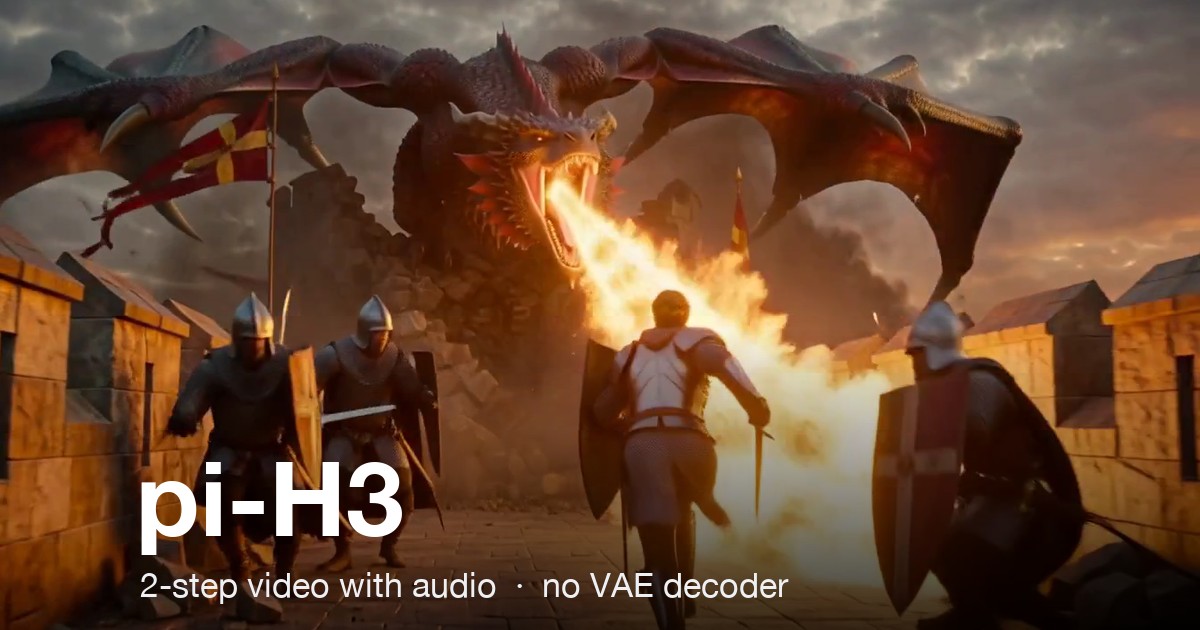
pi-H3: Video Generation in 2–4 Steps Without a VAE Decoder [README]
Blog post, 2026
Hansheng Chen1*, Shengqu Cai1, Jiaming Song†, Gordon Wetzstein1, Xinchen Yan†, Leonidas Guibas1
1Stanford University
*Part of work done during an internship at Luma AI, †Work done while at Luma AI
Blog | ComfyUI | pi-H3 Demo🤗 -
Asymmetric Flow Models [README]
In NeurIPS 2026
Hansheng Chen, Jan Ackermann, Minseo Kim, Gordon Wetzstein, Leonidas Guibas
Stanford University
Project Page | arXiv | ComfyUI | AsymFLUX.2 klein Demo🤗
-
pi-Flow: Policy-Based Few-Step Generation via Imitation Distillation [README]
In ICLR 2026
Hansheng Chen1, Kai Zhang2, Hao Tan2, Leonidas Guibas1, Gordon Wetzstein1, Sai Bi2
1Stanford University, 2Adobe Research
arXiv | ComfyUI | pi-Qwen Demo🤗 | pi-FLUX Demo🤗 | pi-FLUX.2 Demo🤗
-
Gaussian Mixture Flow Matching Models [README]
In ICML 2025
Hansheng Chen1, Kai Zhang2, Hao Tan2, Zexiang Xu3, Fujun Luan2, Leonidas Guibas1, Gordon Wetzstein1, Sai Bi2
1Stanford University, 2Adobe Research, 3Hillbot
arXiv



-
[Nov 21, 2026] pi-H3 is released, the fastest MiniMax H3, with ComfyUI support. Try the pi-H3 Demo🤗.
-
[May 20, 2026] AsymFlow is now supported in our ComfyUI extension.
-
[May 14, 2026] AsymFlow is released.
-
[Dec 12, 2025] pi-FLUX.2 is now available for 4-step image generation and editing. Check out the pi-FLUX.2 Demo🤗. Please re-install the latest version of LakonLab (this repository) to use pi-FLUX.2.
-
[Nov 7, 2025] ComfyUI-piFlow is now available. Supports 4-step sampling of Qwen-Image and Flux.1 dev using 8-bit models on a single consumer-grade GPU, powered by ComfyUI.
The code has been tested in the following environment:
- Linux (tested on Ubuntu 20 and above)
- PyTorch 2.9+ (most tested on 2.10 and 2.11)
With the above prerequisites and setuptools installed, run pip install -e . --no-build-isolation from the repository root to install the LakonLab codebase and its dependencies.
An example of installation commands is shown below:
# Move to this repository (the folder with setup.py) after cloning
cd <PATH_TO_YOUR_LOCAL_REPO>

# Create uv environment (uv's managed Python includes the headers needed to build CUDA extensions)
uv venv --python 3.10 --managed-python
source .venv/bin/activate

# Install the build tool required by --no-build-isolation
uv pip install "setuptools<74"

# Install Pytorch. Goto https://pytorch.org/get-started/previous-versions/ to select the appropriate version
uv pip install torch==2.10.0 torchvision==0.25.0 --index-url https://download.pytorch.org/whl/cu128

# Install LakonLab in editable mode
uv pip install -e . --no-build-isolation
Additional notes:
-
If
LD_LIBRARY_PATHpoints to a system CUDA installation of a different version than your PyTorch build, PyTorch may load mismatched cuBLAS libraries and fail withCUBLAS_STATUS_INVALID_VALUE. Remove those paths fromLD_LIBRARY_PATHin that case. -
Building CUDA extensions from source requires a CUDA toolkit with
nvccthat supports your PyTorch build and target GPU, and a C++ compiler supported by that toolkit. -
The CUDA extensions under lakonlab/ops are optional and compile on first use. The quant extension (INT8 GEMM, currently Hopper only) also needs a CUTLASS checkout at
CUTLASS_PATH, otherwise Triton kernels are used. To prebuild the extensions at install time, setBUILD_EXT:CUTLASS_PATH=<PATH_TO_CUTLASS> BUILD_EXT=quant,gmflow_ops uv pip install -e . --no-build-isolation
-
To use the optional GMuon optimizer, install LakonLab with the
gmuonextra. -
To access FLUX models, please accept the FLUX.2 klein Base 9B conditions and FLUX.1 dev conditions, and then run
hf auth loginto login with your HuggingFace account.
Install the optional sol extra from the repository root to enable Sol-Attn sparse attention on supported GPUs.
uv pip install -e '.[sol]' --no-build-isolationWith a CUDA 13 build of PyTorch, also add 'nvidia-cutlass-dsl[cu13]' to that command to install the CUDA 13 CuTe runtime (see the CuTe DSL installation guide).

LakonLab is a high-performance codebase for experimenting with large diffusion models. Key features of LakonLab include:
-
Performance optimizations:
- Parallelism: Seamless switching between DDP, FSDP, and FSDP2, all supporting gradient accumulation and mixed precision.
-
Compilation:
torch.compileis opt-in per module (compile_forward), with warmup support (bucket_warmup) so that every shape variant is compiled up front rather than mid-run. -
Attention backends: Alternative attention backends such as FlashAttention and SageAttention are supported per module via the
attention_backend_configmodel setting. -
8-bit quantization: Frozen linear layers can be quantized to W8A8 types. Supports
fp8,fp8_blockwise,int8,int8_smoothquant,int8_convrot. Enabled via thefreeze_quant_configmodel setting. - Weight tying: For LoRA fine-tuning, the base weights of the teacher, student, and EMA models are tied, sharing the same underlying memory. This is compatible with DDP and FSDP.
-
Advanced flow solvers:
-
FlowSDEScheduler: Generic flow SDE solver with an adjustable stochasticity parameter
h, following
$$dx_t=\left(f_t x_t - \frac{1 + h^2}{2} g_t^2 s_t(x_t)\right) dt + h g_t d \bar w_t ,$$
where$s_t=\nabla\log p_t$ ,$f_t=-1/(1-t)$ , and$g_t=\sqrt{2t/(1-t)}$ .h=0gives a flow ODE,h=1a standard flow SDE, andh='inf'full re-noising. -
FlowMapSDEScheduler: Generic flow SDE solver for few-step flow map models, with the same adjustable stochasticity parameter
h.
-
FlowSDEScheduler: Generic flow SDE solver with an adjustable stochasticity parameter
-
Storage backends: Most I/O operations (e.g., dataloaders, checkpoint I/O) support both local filesystems and AWS S3. In addition, model checkpoints can be loaded from HuggingFace (link format
huggingface://<HF_REPO_NAME>/<PATH_TO_MODEL>) and HTTP/HTTPS URLs directly. -
Streamlined training and evaluation: Supports online evaluation using common metrics, including FID, KID, IS, Precision, Recall, CLIP similarity, VQAScore, HPSv2, and HPSv3. Supports exporting results to offline evaluators, including HPSv3 Benchmark, DPG-Bench, GenEval and LongText-Bench.
-
3rd-party model inference reproduction:
-
ImageNet 256x256 models with ADM evaluation:
Model FID (reproduced) FID (official) SiT-XL/2 2.05 2.06 JiT-H/16 1.90 - DiT-XL RAE (unguided) 1.50 1.51 REPA-XL/2 1.38 1.42 REPA-E-XL VAVAE 1.12 1.12 Note:
We use BF16 inference for all models except RAE.
Original JiT paper uses its own evaluation protocol that differs from ADM evaluation. -
Text-to-image models:
See examples in configs/misc and lakonlab/models/architectures/diffusers.
-
LakonLab uses the configuration system and code structure from MMCV.
- Sol-Attn: vendored and adapted from NVIDIA Sol-Engine (license and credits).
@misc{chen2026pih3,
  title        = {{pi-H3: Video Generation in 2–4 Steps Without a VAE Decoder}},
  author       = {Hansheng Chen and Shengqu Cai and Jiaming Song and Gordon Wetzstein and Xinchen Yan and Leonidas Guibas},
  year         = {2026},
  month        = nov,
  howpublished = {\url{https://hanshengchen.com/blog/pi-h3/}}
}

@article{chen2026decoding,
  title={Decoding Without a Decoder: Direct Pixel Prediction from Diffusion Transformers},
  author={Hansheng Chen and Shengqu Cai and Jan Ackermann and Rayhan Zirvi and Gordon Wetzstein and Xinchen Yan and Leonidas Guibas},
  journal={arXiv preprint arXiv:2611.22287},
  url={https://arxiv.org/abs/2611.22287},
  year={2026},
}

@article{asymflow,
  title={Asymmetric Flow Models},
  author={Hansheng Chen and Jan Ackermann and Minseo Kim and Gordon Wetzstein and Leonidas Guibas},
  url={https://arxiv.org/abs/2605.12964},
  journal={arXiv preprint arXiv:2605.12964},
  year={2026},
}

@article{piflow,
  title={pi-Flow: Policy-Based Few-Step Generation via Imitation Distillation},
  author={Hansheng Chen and Kai Zhang and Hao Tan and Leonidas Guibas and Gordon Wetzstein and Sai Bi},
  url={https://arxiv.org/abs/2510.14974},
  journal={arXiv preprint arXiv:2510.14974},
  year={2025},
}

@article{gmflow,
  title={Gaussian Mixture Flow Matching Models},
  author={Hansheng Chen and Kai Zhang and Hao Tan and Zexiang Xu and Fujun Luan and Leonidas Guibas and Gordon Wetzstein and Sai Bi},
  url={https://arxiv.org/abs/2504.05304},
  journal={arXiv preprint arXiv:2504.05304},
  year={2025},
}